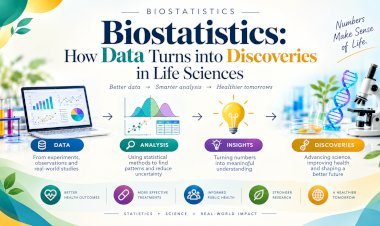
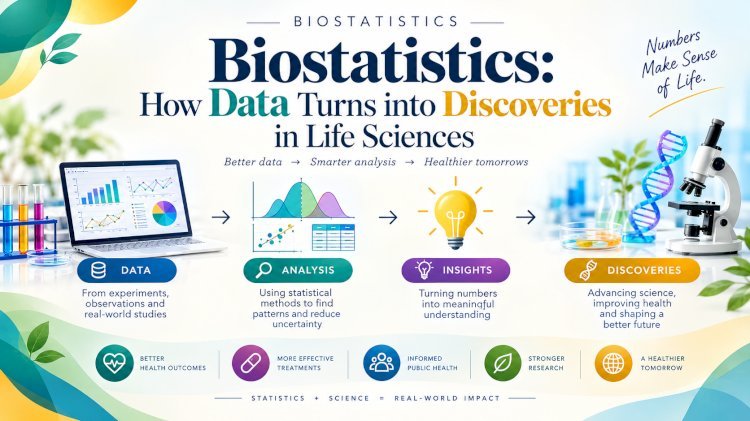
Biostatistics: How Data Turns into Discoveries in Life Sciences
Discover biostatistics, its applications in clinical trials and life sciences, essential skills, career opportunities, and biostatistics training at IBRI.
 Mithilesh Kumar MIshra
Oct 24, 2026 03:56
34
0
What If Data Could Tell a Story?
Imagine you are working on a research project to investigate whether a new drug helps patients recover faster. You collect data from 200 participants, record their recovery times, and compare the results between two groups.
But here is the big question: How do you know whether the drug actually works, or whether the difference you observed happened by chance?
This is where biostatistics comes into the picture!
Biostatistics combines statistical principles with biological, medical and health-related research to help researchers analyse data, evaluate evidence and draw meaningful conclusions.
From developing new medicines to studying disease outbreaks and understanding genetic variations, biostatistics plays an important role in modern scientific research.
If you are a student of biotechnology, bioinformatics, microbiology, pharmacy, nursing or any other life-science discipline, understanding biostatistics can help you become a more confident researcher.
Let's explore how !!
1. What Is Biostatistics?
Biostatistics is the application of statistical methods to biological, medical, clinical and public health data.
It helps researchers answer questions such as:
-
Does a new treatment produce better results than an existing treatment?
-
Is a particular disease more common in one population than another?
-
Is a genetic variation associated with an increased risk of disease?
-
Does a laboratory experiment provide statistically meaningful evidence?
-
Can a public health intervention reduce disease incidence?
Rather than relying on assumptions or individual observations, biostatistics helps scientists evaluate evidence systematically.
In simple words: Biology helps us understand living systems, while biostatistics helps us make sense of the data generated when studying them.
2. Why Is Biostatistics Important in Life Sciences?
Scientific research generates enormous amounts of data. However, collecting data is only the first step. Researchers must also understand what the data means, how reliable the findings are and what conclusions can reasonably be drawn.
Here are five important applications of biostatistics.
A. Clinical Trials and Drug Development
Before a new medicine can be considered effective and safe for its intended use, researchers must evaluate evidence from carefully designed studies.
Biostatistics supports clinical trial design, sample-size estimation, randomisation, statistical analysis and interpretation of outcomes.
For example, researchers comparing two treatments may use statistical methods to determine whether the observed difference in patient outcomes provides convincing evidence of a treatment effect.
B. Epidemiology and Public Health
How do researchers investigate disease patterns across populations?
Biostatistics helps analyse disease incidence, prevalence, risk factors and the outcomes of public health interventions.
It can support investigations into infectious diseases, chronic illnesses, environmental exposures and population health trends.
C. Genetics and Genomics
Modern genetics and genomics research can generate thousands or millions of measurements.
Biostatistical approaches help researchers identify patterns in genetic variation, investigate associations between genetic variants and traits, and analyse large-scale biological datasets.
This is particularly relevant to students interested in genomics, bioinformatics and precision medicine.
D. Laboratory and Experimental Research
Suppose you perform an experiment to compare the growth of cells under two different conditions.
Biostatistics can help you summarise measurements, compare groups, assess variability and interpret the evidence.
It also helps researchers distinguish between statistical significance and biological importance — two concepts that should not be confused.
E. Biotechnology and Pharmaceutical Research
Biostatistics contributes to the analysis of biological experiments, product evaluation, quality-related studies and pharmaceutical research.
It can also support the development and validation of analytical approaches used to evaluate scientific and clinical data.
Think about it: Almost every field that generates biological data can benefit from appropriate statistical reasoning.
3. Interactive Challenge: Can You Think Like a Biostatistician?
Let's test your understanding with a simple research scenario.
A research team wants to compare the effectiveness of two treatments. They recruit 100 eligible participants and randomly assign 50 participants to each treatment group.
After the study, the researchers observe that participants receiving Treatment A appear to recover faster on average.
What should the researchers do next?
A. Immediately declare Treatment A the winner.
B. Analyse the data using an appropriate statistical method and evaluate the uncertainty in the results.
C. Ignore the results because both groups received treatment.
D. Repeat the study until Treatment A shows a better result.
Pause here and choose your answer before reading further!
Correct answer: B.
An observed difference does not automatically establish that one treatment is more effective. Researchers need to examine the study design, outcome measurements, variability, effect size, uncertainty and other relevant factors before drawing conclusions.
That is the value of biostatistics: it helps transform observations into evidence-based interpretations.
4. Essential Biostatistics Concepts Every Life-Science Student Should Know
You do not need to become a mathematics expert overnight. Start by understanding the concepts that frequently appear in biological research.
Descriptive Statistics
Descriptive statistics summarise the main characteristics of a dataset.
Important concepts include:
-
Mean, median and mode
-
Range and standard deviation
-
Frequency distributions
-
Tables, graphs and data visualisation
Example: Calculate the average height of a group of plants grown under identical experimental conditions.
Probability and Sampling
Researchers often study a sample rather than an entire population. Probability and sampling concepts help them understand how observations are selected and how sampling uncertainty affects conclusions.
Example: Selecting a representative sample of patients for a clinical study.
Hypothesis Testing and P-Values
Hypothesis testing provides a structured way to evaluate evidence against a specified null hypothesis.
A p-value helps assess how compatible the observed data are with that null hypothesis under the assumptions of the statistical model.
Importantly, a p-value does not tell you the probability that the research hypothesis is true, and statistical significance does not automatically imply clinical or biological importance.
Confidence Intervals and Effect Sizes
A confidence interval communicates uncertainty around an estimated quantity, while an effect size describes the magnitude of an observed relationship or difference.
These concepts help researchers look beyond a simple significant/not-significant result.
Correlation and Regression
Correlation measures the strength and direction of an association between variables. Regression methods help model relationships between an outcome and one or more explanatory variables.
Remember: correlation does not necessarily imply causation.
Choosing the Right Statistical Test
Different research questions and data types require different statistical approaches.
For example, a researcher comparing two independent group means may consider a t-test if its assumptions are appropriate. Categorical outcomes may require a chi-square test or another suitable method.
The right choice depends on the study design, data distribution, independence of observations and the question being investigated.
5. Which Tools Can Help You Learn Biostatistics?
Understanding statistical concepts is essential, but learning how to apply them using analytical tools can make your skills more useful in research.
Depending on your learning goals, you may explore:
-
Microsoft Excel: Basic data organisation, calculations, tables and charts.
-
R: Statistical computing, data visualisation and reproducible analysis.
-
Python: Data manipulation, visualisation and statistical analysis.
-
SPSS: Statistical analysis through a widely used graphical interface.
-
SAS: Statistical analysis used in various research and pharmaceutical settings, including clinical research.
You do not need to master every tool at once. Start with the fundamentals, then choose software that fits your research objectives and the skills you want to develop.
For students interested in clinical trials, research methodology and pharmaceutical research, understanding the reasoning behind statistical methods is just as important as learning the software.
6. Career Opportunities in Biostatistics
Do you enjoy biology but also like working with numbers, patterns and data?
Biostatistics may offer an interesting direction to explore.
Depending on your qualifications, technical skills and experience, related career paths may include:
Biostatistician: Supports statistical planning, analysis and interpretation in research studies.
Clinical Research Associate or Clinical Research Professional: Works on clinical research activities, with responsibilities depending on the role. Statistical knowledge can be useful, although these roles are not identical to biostatistics positions.
Clinical Data Analyst: Helps organise, assess and interpret clinical or health-related datasets.
Epidemiology Research Assistant: Supports studies investigating disease distribution, risk factors and population health.
Research Analyst: Analyses scientific or biomedical data and contributes to research reporting.
Bioinformatics Analyst: Works with computational biological data, potentially combining statistical methods with genomics or other omics analyses.
Potential employers and work settings include academic institutions, hospitals, contract research organisations, pharmaceutical companies, biotechnology organisations and public health research groups.
Keep in mind that each position has different eligibility criteria. Some specialist biostatistician roles require advanced statistical training or a relevant postgraduate qualification.
7. Is Biostatistics Suitable for You?
Biostatistics is worth exploring if you are:
-
A biotechnology or life-science student interested in research.
-
A pharmacy or healthcare student interested in clinical trials.
-
A bioinformatics student who wants to strengthen data-analysis skills.
-
A postgraduate researcher who needs to analyse experimental results.
-
A working professional interested in clinical research or biomedical data.
You do not have to know advanced statistics before you begin. A willingness to learn, practise with datasets and understand research questions can help you build a strong foundation.
8. Explore Biostatistics Training at IBRI
At the Indian Biological Sciences and Research Institute (IBRI), biostatistics is part of the institute's wider focus on life-science and pharmaceutical education.
IBRI's official biostatistics course information describes training options that connect statistical concepts with research methodology, medical statistics and clinical research.
Depending on the programme, the listed areas of study include:
-
Biostatistics concepts, sampling and data analysis.
-
Biostatistics for clinical trials and medical research.
-
Applications of biostatistics across life sciences and other disciplines.
-
Research methodology and research procedures.
-
Epidemiology and related statistical methods in the comprehensive programme.
IBRI lists biostatistics-related programmes with different durations, including certificate-level and comprehensive options. Students should review the official course page to confirm the current curriculum, delivery mode, eligibility and fees before enrolling.
Explore the programme:
https://www.ibri.org.in/biostatisticsdistanc.html
You can also visit the official IBRI website to explore other life-science learning opportunities:
https://ibri.org.in/
Mini Quiz: Test Your Biostatistics Knowledge!
Ready for a quick knowledge check? Try answering these questions without looking back at the article.
Question 1: Which measure is commonly used to describe the spread of numerical observations around the mean?
Question 2: Which statement about correlation is correct?
Question 3: What is one important purpose of biostatistics in clinical trials?
10. Your First Step Towards Data-Driven Research
Biostatistics is more than a collection of formulas. It is a way of thinking critically about scientific evidence.
It helps researchers ask better questions, design stronger studies, recognise uncertainty and communicate findings responsibly.
Whether your interest lies in biotechnology, bioinformatics, clinical trials, genetics or public health, building a foundation in biostatistics can strengthen your research capabilities.
Your turn: If you could analyse one biological or medical dataset, what would you investigate — disease patterns, drug effectiveness, genetic variation or something else?
Share your answer in the comments!
At the Indian Biological Sciences and Research Institute (IBRI), we encourage students and aspiring researchers to explore the skills that connect scientific knowledge with practical research.
Interested in learning more about biostatistics ?
Explore the official course information or contact IBRI to enquire about the programme best suited to your academic background.
Indian Biological Sciences and Research Institute (IBRI)
Website: https://ibri.org.in/
Email: info@ibri.org.in
Phone: +91 99714 41910
Course details, eligibility and fees may change. Please verify the latest information directly with IBRI before applying.
Join the Conversation
What is your biggest challenge when learning biostatistics: understanding statistical concepts, selecting the right test, interpreting p-values, or working with data-analysis software?
Tell us in the comments. Your question could inspire our next student-focused blog!
#Biostatistics #LifeSciences #ClinicalResearch #ResearchMethodology #Biotechnology #Bioinformatics #IBRI #StudentLearning