Clinical Trials Explained: Phases, Ethics & Process in India
Learn how clinical trials work: the four phases, trial design, ethics, India’s CDSCO rules and CTRI registration, and the role of bioinformatics.
 Sheetal
Oct 14, 2026 11:53
86
0
Every medicine on a pharmacy shelf, from a simple paracetamol tablet to a modern cancer immunotherapy, reached patients only after passing through clinical trials. Roughly nine in ten drug candidates that enter human testing never make it to approval, which is exactly why this stage exists: to find out, with evidence, what is safe and what truly works.
In this post, we walk through what clinical trials are, how the four phases differ, how trials are designed and kept ethical, how they run in India, and where bioinformatics is changing the picture.
What Is a Clinical Trial?
A clinical trial is a carefully planned research study in which volunteers receive an intervention, such as a drug, vaccine, device, diagnostic test or behavioural therapy, so researchers can measure its safety and effectiveness in people.
Trials sit in the middle of a long pipeline. A candidate first emerges from target discovery and laboratory work, is tested in cells and animals (preclinical studies), and only then moves into human trials. After the trials, regulators review the evidence before the product can be sold. The whole journey often takes a decade or more.
The Four Phases of Clinical Trials
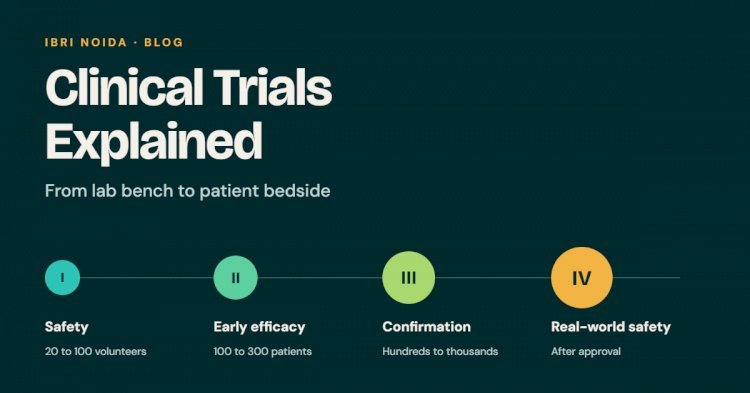
Human trials move through phases, and each one answers a different question. A product advances only if the previous phase gives a clear green light.
| Phase | Typical size | Who takes part | Key question |
|---|---|---|---|
| Phase I | 20 to 100 | Mostly healthy volunteers (patients in some cancer trials) | Is it safe, and what dose does the body tolerate? |
| Phase II | 100 to 300 | Patients with the target condition | Does it show signs of working, and what are the common side effects? |
| Phase III | 300 to several thousand | Large, diverse patient groups | Is it better than the current standard of care? |
| Phase IV | Thousands | Real-world patients after approval | What rare or long-term effects appear once many people use it? |
Sizes are typical ranges and vary widely by disease and product. Phase III results usually form the core of the application submitted to regulators, while Phase IV keeps watching safety for as long as the product is on the market.
How Clinical Trials Are Designed
Good design is what turns an observation into evidence. Four ideas appear again and again:
- Control group: one group receives the new treatment, while another receives a placebo or the current standard treatment, so the difference can be measured.
- Randomisation: participants are assigned to groups by chance, which prevents researchers from unconsciously picking healthier patients for the new treatment.
- Blinding: in a single-blind trial participants do not know their group; in a double-blind trial neither participants nor investigators do, which protects results from expectation bias.
- Endpoints: the outcome measured must be defined in advance, for example tumour shrinkage, blood pressure change or survival time, and the statistical analysis plan is fixed before the data are unblinded.
Ethics and Participant Safety
A participant's rights and safety always outrank the interests of science. Three safeguards protect them:
- Informed consent: before joining, every volunteer is told the purpose, procedures, risks and benefits in plain language, and may withdraw at any time without penalty.
- Independent ethics committee: a panel of doctors, scientists and lay members reviews the protocol before the trial starts and keeps reviewing it while it runs.
- Good Clinical Practice (GCP): an international quality standard covering how trials are designed, conducted, recorded and reported, so that results are credible and participants are protected.
Many trials also use an independent data monitoring committee that can pause or stop a study early if safety concerns arise or if the benefit is already clear.
Clinical Trials in India
India is one of the world's largest hubs for clinical research, thanks to its diverse population, high disease burden and strong pool of trained scientists. The framework is built on a few key pieces:
- CDSCO and the DCGI: the Central Drugs Standard Control Organisation, headed by the Drugs Controller General of India, approves clinical trials and new drugs under the New Drugs and Clinical Trials Rules, 2019.
- Registered ethics committees: each trial site must be overseen by an ethics committee registered under these rules.
- CTRI registration: trials must be registered in the Clinical Trials Registry - India before the first participant is enrolled, which keeps trial information public and transparent.
- ICMR guidelines: the Indian Council of Medical Research's national ethical guidelines set expectations for consent, privacy and the protection of vulnerable groups.
The 2019 rules also require compensation for participants who suffer trial-related injury or death, and the informed consent process is documented, including audio-visual recording in the prescribed cases.
Where Bioinformatics Fits In
Computational biology now touches almost every stage of the trial pipeline, from the first idea to the final analysis.
- Before the trial: computer-aided drug discovery, molecular docking and simulation help prioritise candidates, so fewer weak molecules reach patients.
- Choosing the right patients: genomic and biomarker data let researchers enrol people most likely to respond, the basis of precision medicine.
- Pharmacogenomics: variants in drug-metabolising genes explain why the same dose helps one person and harms another.
- During and after the trial: statistical modelling, adaptive designs and real-world data analysis help teams spot signals earlier and learn more from every participant.
For students and early-career scientists, this overlap between data skills and clinical science is one of the most exciting career areas in the life sciences.
Challenges and the Road Ahead
Clinical trials are slow and expensive, and recruiting and retaining volunteers remains the most common reason studies run late. Representation is another gap: results are only as useful as the population they were tested in, so including women, older adults and different regions and ethnic groups matters.
New approaches are easing some of these barriers: decentralised trials that bring visits closer to home, electronic consent, wearable sensors for continuous monitoring, and AI tools that match patients to suitable studies.
The takeaway is simple. Clinical trials are how medicine earns trust, one carefully measured result at a time, and every approved treatment exists because ordinary volunteers took part. Understanding the process helps all of us ask better questions, and make better decisions, about our health.
This post is for educational purposes only and is not medical advice. Please consult a qualified doctor about your own health.